
Languages and family life
Raising a bilingual baby in Sweden
You do not have to choose between Swedish and the language that connects your child to family. Babies can grow up with more than one language. What helps most is plenty of warm, everyday conversation, not a perfect language schedule.
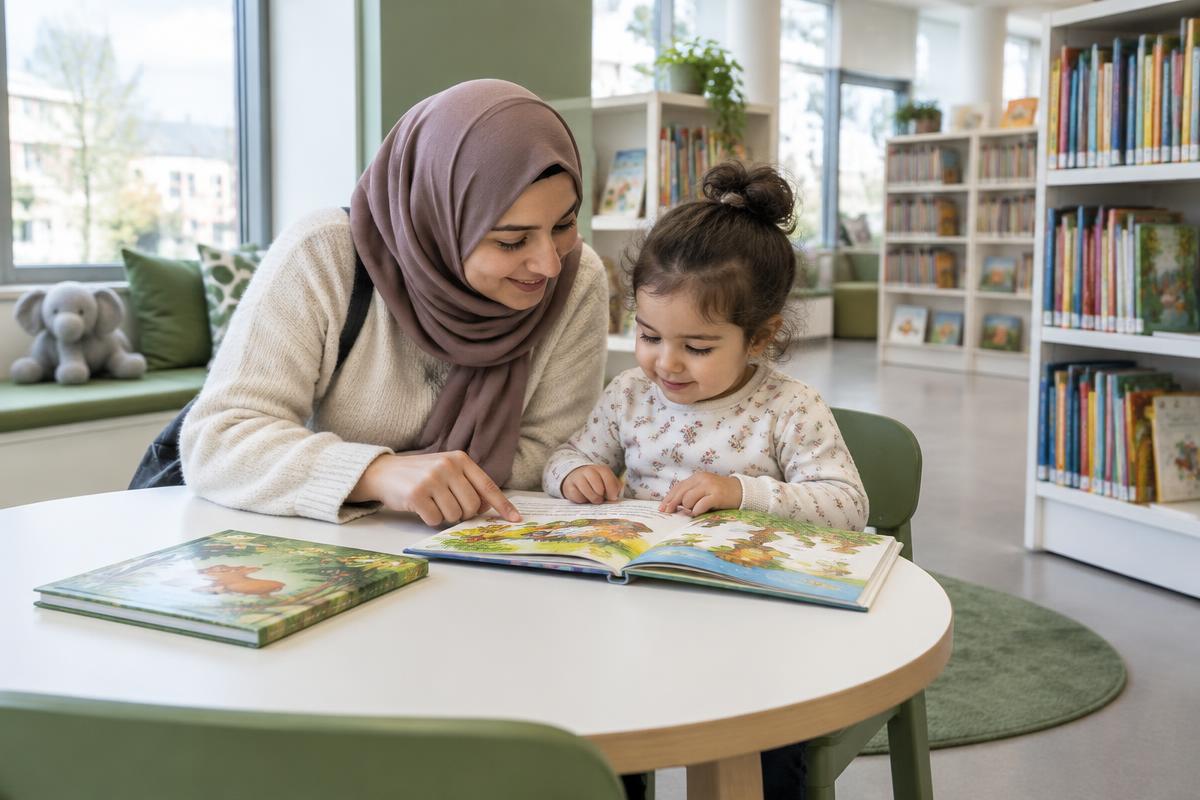
Start with the language you feel close in
Speak, sing and tell stories in the languages you use comfortably. You do not need to switch to Swedish at home just because your child will hear Swedish at preschool. Family conversation helps keep your home language alive.
‘One parent, one language’ is one possible routine, not a requirement. Some families use a home language together; others use different languages with different relatives or in different situations. Choose something your family can enjoy and sustain.
Build small routines, not language lessons
- At meals and nappy changes, describe what you and your baby are doing. Pause and respond to their sounds, gestures and words.
- Share a picture book, song or nursery rhyme in your home language. Talk about the pictures; you do not have to read every word.
- Let grandparents or other relatives join regular calls. Make it a conversation around a toy or a story, rather than asking your child to perform.
- Ask your local library about children's books in your languages and look for playmates who use them too.
There is no universal number of minutes that guarantees bilingual fluency. Children need opportunities to hear and use each language, and their stronger language can change over time.
Mixing languages is not confusion
A child may use a Swedish word in an Arabic sentence, or answer in a different language from the one you used. Mixing languages is a normal part of multilingual communication, not by itself a sign of a problem.
Respond to the meaning first. You can gently repeat the idea in your language without turning every conversation into a correction. Notice what your child understands and communicates across all their languages, not Swedish alone.
What to ask your Swedish preschool
Swedish preschool should give children with another mother tongue opportunities to develop both Swedish and their mother tongue. Ask staff what this looks like in your preschool; it does not automatically mean a separate lesson or a teacher who speaks every language.
- Tell staff which languages your child hears and uses, and share a few comforting words or favourite songs.
- Ask whether multilingual books, recordings or family contributions can be part of the day.
- Compare notes about how your child communicates at home and at preschool, especially while settling in.
When to ask BVC for help
Learning more than one language does not itself cause a speech or language disorder. But multilingual children can have difficulties too, so do not dismiss a concern as ‘just bilingualism’.
If you are worried about hearing, understanding, communication or the loss of skills your child previously had, contact BVC. Explain what you notice in every language and ask for an interpreter if needed. A speech-language therapist can consider the whole language picture.
Sources and further reading
Last reviewed 15 October 2026
Written by Circle for general orientation, not a diagnosis. Ask your BVC nurse or a speech-language therapist about your child's development.